AI LinkedIn Content Workflow for Strong Personal Branding
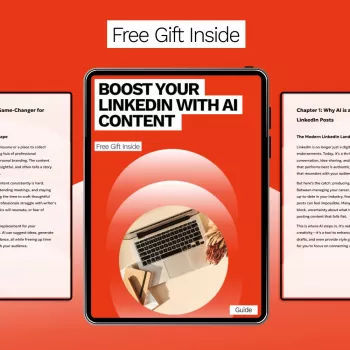
Boost Your LinkedIn with AI Content: A Practical Guide for Stronger Personal Branding
Consistent, thoughtful LinkedIn posting builds visibility and credibility, but time and blank-page pressure can slow progress. AI can speed up ideation, drafting, and repurposing—while still sounding human—when it’s used with clear inputs, a repeatable workflow, and a quality check that protects accuracy and trust.
What AI Can (and Can’t) Do for LinkedIn Writing
AI works best as a drafting partner—not a substitute for your judgment or lived experience.
- Use AI for starting points: topic ideas, outlines, first drafts, hooks, and alternative angles.
- Use AI for editing: clarity, structure, tone alignment, headline variations, and concise rewrites.
- Avoid outsourcing judgment: claims, numbers, client outcomes, and sensitive details must be verified and approved.
- Keep ownership: final voice, opinions, and real experiences should come from the author, not the tool.
When uncertainty exists—policy details, tool capabilities, or anything that could affect your reputation—verify through primary sources like the LinkedIn Help Center and the LinkedIn Professional Community Policies.
A Simple AI Workflow for Weekly Posting (Momentum Over Perfection)
Momentum comes from a workflow you can repeat on busy weeks. Keep it small, specific, and publishable.
- Pick one weekly theme tied to a single professional pillar (role expertise, industry insights, career lessons, or behind-the-scenes process).
- Batch ideation in 10 minutes: generate 10 hooks and select 2 that feel specific and believable.
- Draft fast, then refine: produce a rough version first, then run one edit pass for structure and one for voice.
- Add proof and specificity: insert real examples, decisions made, tradeoffs, metrics (only if accurate), and what changed afterward.
- Publish, then recycle: turn one post into a short carousel outline, a comment strategy, and a follow-up post.
A helpful rule: if a sentence could apply to anyone, it’s not ready. Replace it with what happened, what you chose, and what it cost (time, focus, risk, or tradeoffs).
Write Posts That Sound Like You: Voice, Boundaries, and Authenticity Checks
Create a one-paragraph voice card
- Tone: direct, friendly, analytical (choose 1–2).
- Sentence style: short punchy lines vs. longer explanatory ones.
- Phrases to avoid: anything you’d never say out loud.
Set boundaries before you draft
- Topics requiring extra care: clients, employer info, medical/legal/financial advice, confidential roadmaps, or internal numbers.
- What you will generalize: company names, exact timelines, tool stacks, or identifiable details.
Run a “human pass”
- Remove generic adjectives (e.g., “game-changing,” “incredible,” “revolutionary”).
- Add concrete nouns (a specific meeting, spreadsheet, hiring loop, deadline, stakeholder).
- Replace vague lessons with a real moment or decision (what you said no to, what you shipped, what you changed).
Use disclosure wisely
If AI materially helped draft the post, keep the content truthful and fully owned. Transparency matters most when the post could be interpreted as an endorsement, testimonial, or performance claim—areas where standards like the FTC Endorsement Guides may be relevant.
Post Formats That Perform Well with AI Assistance
AI is most useful when the format is defined. Pick a structure first, then ask AI to fill gaps, tighten wording, and offer alternatives.
- Opinion + reasoning: a clear stance, 2–3 supporting points, and a practical takeaway.
- Mini case study: context → problem → approach → result/learning (avoid sharing confidential details).
- Framework post: a simple model (3–5 steps) with a quick example for each step.
- Myth vs reality: call out a common misconception and explain the nuance.
- Career reflection: a lesson learned, what changed in behavior, and what to try next.
| Goal | Best format | Suggested structure | Where AI helps most |
|---|---|---|---|
| Get discovered by new audiences | Framework post | Hook → 3–5 steps → example → question | Generate step options, tighten wording, create alternate hooks |
| Build credibility | Mini case study | Context → problem → approach → outcome → lesson | Outline sequencing, simplify explanations, create a succinct version |
| Start conversations | Myth vs reality | Myth → why it’s tempting → reality → what to do instead | Brainstorm myths, craft counterpoints, refine a discussion question |
| Show leadership | Opinion post | Stance → reasoning → tradeoffs → call to action | Create counterarguments, strengthen logic, reduce fluff |
| Strengthen personal brand | Career reflection | Moment → insight → behavior change → advice | Turn notes into narrative, improve flow, produce multiple lengths |
Practical Guardrails: Accuracy, Compliance, and Professional Risk
- Verify all factual claims: dates, stats, tool capabilities, policy details, and quoted sources.
- Avoid fabricated specifics: no invented client names, fake metrics, or implied endorsements.
- Respect confidentiality: remove identifying details; generalize scenarios when necessary.
- Reduce “overconfident tone”: use cautious language for uncertain topics and add citations when referencing public facts.
Turn One Idea into a Month of Content (Repurposing Plan)
A Practical Digital Guide for Faster, Better LinkedIn Drafts
If a quick, repeatable system would help, consider Boost Your LinkedIn with AI Content (digital download) for practical templates, examples across formats, and a quality checklist focused on accuracy and authenticity.
For another practical digital download focused on home routines, Simple Ways to Control Pet Hair at Home (Digital Download) is a separate, handy reference when you want a structured plan you can follow quickly.
FAQ
How often should LinkedIn posts be published to see steady growth?
A realistic range is 2–4 times per week, with consistency mattering more than volume. Batching one draft session and repurposing one idea into multiple formats helps keep momentum even during busy weeks.
How can AI-written LinkedIn posts avoid sounding generic?
Give AI constraints (your role, audience, and a specific moment) and add personal details like the decision you made, the tradeoff you accepted, and what changed afterward. A quick “human pass” to remove clichés and add concrete nouns usually makes the biggest difference.
Is it acceptable to use AI to write LinkedIn content?
Yes—when the post is truthful, verified, and reflects your real perspective. Avoid fabricated outcomes, protect confidentiality, and make sure any endorsements or performance claims are accurate and responsibly presented.














Leave a comment